
Not long ago, a client sat across from me on the lounge in my counselling room, her shoulders tense, hands tightly clasped in her lap, her body guarded. When I gently enquired what was going on for her in the moment, she paused and then quietly said, “I don’t even know where to start, I feel so overwhelmed.”
What she was carrying felt too big for words. The grief, anxiety, anger, guilt, sorrow, disgust, confusion and exhaustion – it had all become tangled together, leaving her nervous system overwhelmed and her mind struggling to make sense of it all. As we sat together, it became clear that trying to explain and process everything verbally felt almost impossible for her and was not the best starting place.
Moments like this are not uncommon in counselling. I often sit with people who arrive holding emotions that feel too heavy, too complex, or too painful to put into words. When the nervous system is flooded with experiences like trauma, loss, deep sadness, or chronic stress, the brain can struggle to organise those feelings into language.
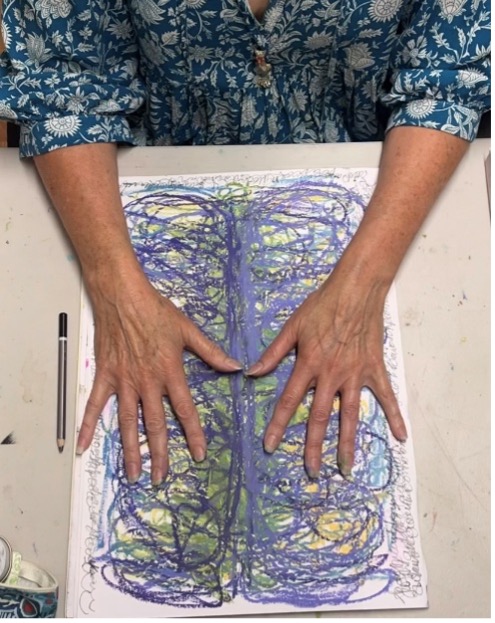
This is why I love integrating creative approaches such as bilateral drawing and art therapy into the counselling process.
Sometimes, processing and healing don’t begin with words or talking. Sometimes it begins with a piece of paper, two crayons/pencils, and permission for the body to gently release what the heart has been holding.
In this blog, I want to explore:
- How bilateral drawing works
- Why does it help calm the nervous system
- How simple creative practices can support the brain in processing big emotions…..
Bilateral drawing is one of the most effective techniques for calming the nervous system and facilitating the release of stored-up big emotions and experiences from the body.
This simple practice involves drawing with both hands at the same time—often mirroring movements across the page. It may feel unusual at first, but it allows the brain and nervous system to process emotions in a way that talking alone sometimes cannot.
When emotions build up in the body, they carry energy. The Psalms remind us that God created us as whole beings—body, mind, and soul—and healing often happens when all parts of us are invited into the process. Bilateral drawing gently releases stored emotional energy while creating space for calm and reflection.
In sessions, clients might begin by simply moving both hands across paper with crayons or pastels. There is no pressure to create something beautiful. The focus is on movement, expression, and allowing the body to speak. Often, people notice that as their hands move, their breathing slows, their shoulders drop, and their emotions begin to shift.
How Does Bilateral Drawing it Work? The Neurobiology behind Bilateral Drawing.
Research in neuroscience helps explain why this technique can be so regulating and healing for our nervous systems.
Bilateral movement engages both sides of the brain and supports emotional processing in several ways:
- It activates both hemispheres of the brain
Drawing with both hands stimulates the left and right hemispheres simultaneously, helping integrate logical processing with emotional experience. - Supports trauma processing pathways
Bilateral stimulation is similar to mechanisms used in trauma therapies such as EMDR. It helps the brain process stuck emotional memories rather than avoiding them. - Reduces amygdala reactivity
Gentle rhythmic movement can calm the brain’s threat detection system (the amygdala), reducing feelings of overwhelm and anxiety. - Engages the sensorimotor system
Moving both hands allows emotions stored in the body to be expressed physically and outwardly onto the page rather than remaining trapped internally. - Strengthens neural integration
The coordination required encourages communication between brain regions, supporting emotional regulation and cognitive clarity. - Activates the parasympathetic nervous system
The repetitive, rhythmic motion helps shift the body out of fight-or-flight into a calmer rest-and-digest state.
Is Bilateral Drawing okay for Christians?
Absolutely – It acts as a Sacred Space for Connection & Expression
For many people, bilateral drawing becomes a prayerful practice. As the hands move, the heart begins to soften. Clients often describe a sense of “letting go” or releasing something they have been holding for a long time.
In my counselling room, I sometimes remind people that God meets us not only in our words but also in our creative expression. Just as the Psalms contain raw emotion, our drawings can serve as a holding space for anger, sorrow, confusion, and hope – we can approach this as a prayerful lament, just as we can through verbal or written prayers cried out to God in difficult times.
You do not need to be an artist to try bilateral drawing. All you need is paper, something to draw with, and permission to let your hands move freely.
Practices like bilateral drawing remind us that our emotions are not only held in our thoughts, but also in our nervous system, our muscles, and our breath. As we create space for movement and expression, the mind and body can begin to work together again.
From a faith perspective, this process can also be deeply comforting. We are reminded that we are created as whole beings—body, mind, and spirit—and that God gifts us a variety of different ways to express ourselves and gently meets us in every part of our life journey.
In the quiet moments of bilateral drawing, so much can happen; there can be a sense of release, calm and gentle restoration as what once felt overwhelming begins to soften, move and be transformed.
If you’re feeling weighed down by emotions or experiences that are difficult to put into words, you are not alone. Gentle practices like bilateral drawing can be a simple place to begin.
If you would like support in exploring creative and faith-integrated approaches to healing, I invite you to reach out or book a counselling session. Together, we can create a safe space for your story, your emotions, and your healing journey.
From my heart to yours,
Narelle & the Bethesda Team